
To read prescription bottles in 2026, start with the patient’s name, medication name, strength, and directions, then check the warnings, storage instructions, and pharmacy contact information. If anything is unclear or differs from what you expected, ask the dispensing pharmacist to explain it before taking the medication.
- Read prescription bottles by checking the patient, medication, strength, directions, warnings, and storage instructions.
- The Rx number identifies the prescription; it does not tell you the dose.
- Ask the dispensing pharmacist about unclear directions instead of guessing from abbreviations or pill appearance.
- FujiMochi supplies Rx vials to independent pharmacies; medication instructions come from the dispensing pharmacy.
Why this matters: A bottle can show the right medication name while containing directions or a strength you did not expect. For pharmacy owners, readable labels belong in the packaging discussion alongside vial and cap selection; the prescription bottles buyer’s guide for pharmacies covers that purchasing side.
How to read a prescription bottle label
Read the directions as a complete instruction, not as a collection of separate numbers. The medication strength, amount to take, frequency, and route describe different things. Treating one as a substitute for another creates confusion.
Use this sequence each time you receive a prescription, including a refill. Label placement varies, so look for the information rather than expecting it in a particular corner.
- Patient name: Confirm that the prescription belongs to you or the person whose medication you manage.
- Medication name: Read the name and compare it with what you expected to receive.
- Strength: Find the amount of active ingredient stated for the tablet, capsule, liquid, or other dosage form.
- Directions: Read how much to use, how to use it, and when to use it.
- Warnings: Read the main label and any additional stickers.
- Storage: Check the temperature, handling, and disposal information supplied with the medication.
- Pharmacy contact: Locate the phone number and prescription number so you can ask a precise question.
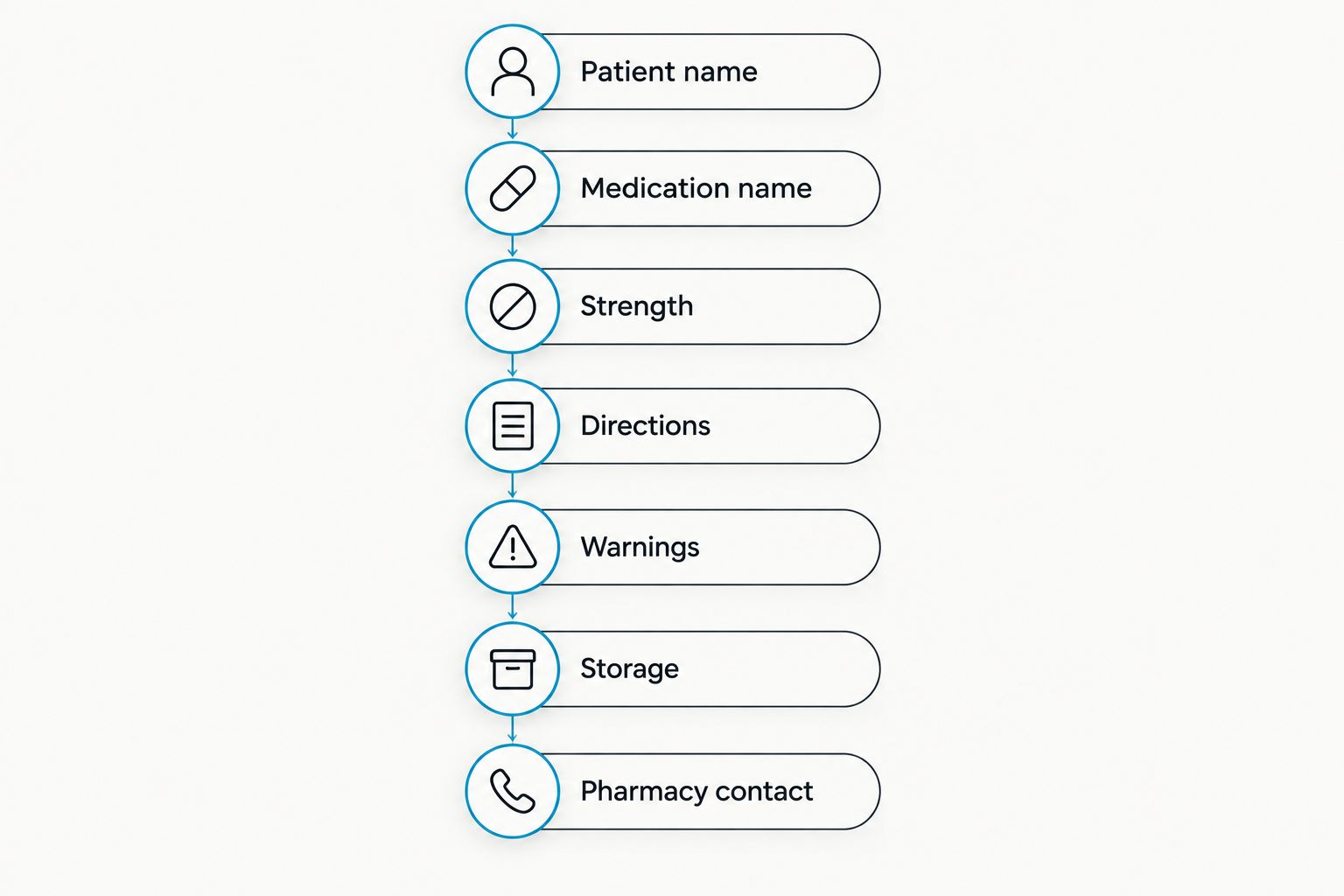
The label is your starting point, not a replacement for the medication information supplied with it. Read those materials too, especially when a medicine is new to you or its directions have changed.
What each part of a prescription label tells you
The following distinctions apply when checking prescription bottles in 2026. Not every pharmacy uses the same layout or wording, and some details appear on separate paperwork rather than on the bottle itself.
| Label field | What it tells you | What not to assume |
|---|---|---|
| Patient name | Who the prescription is intended for | A familiar medication name means the bottle belongs to you |
| Medication name | The drug dispensed, sometimes with brand or generic information | A different-looking name automatically means a dispensing error |
| Strength | The amount of active ingredient associated with the stated dosage unit or concentration | Strength is the same as the amount you should take |
| Directions | How the medication is prescribed for you | You should follow an older bottle instead |
| Quantity | The amount dispensed | The quantity tells you the dosing schedule |
| Rx number | The pharmacy’s reference for that prescription | It identifies the dose or medication strength |
| Refills | Refill information recorded for the prescription | A refill can be filled without checking timing or prescription status |
| Dates | The date described by the accompanying wording | Every date means the medication expires then |
Read the field name with the value. A number beside “quantity” answers a different question from a number inside the directions. If the print is difficult to read, ask the pharmacy for help rather than interpreting an isolated number.
Medication strength is not your dose
Strength describes the medication’s stated potency or concentration. Your dose is the amount prescribed for you to take or use at a particular time.
Those details work together, but they are not interchangeable. The directions determine the prescribed amount; do not calculate a new dose from the strength alone.
For liquids, pay particular attention to the units and concentration. Ask the pharmacist which measuring device to use and how to measure your prescribed amount. Household spoons are not reliable medication-measuring devices.
The Rx number is a reference, not an instruction
The Rx number helps the dispensing pharmacy locate the prescription in its records. Keep it handy when you call about a refill, a label question, or a possible discrepancy.
Do not confuse it with the prescriber’s instructions. Reading the Rx number correctly does not explain when or how much medication to take.
How do you interpret the directions correctly?
Read the entire directions line aloud. Identify the amount, route, timing, and any condition attached to taking the medication before deciding what it asks you to do.
- Amount: What quantity does the label tell you to take or use?
- Route: Does the instruction say by mouth, on the skin, in the eye, or another route?
- Timing: Does it specify particular times, intervals, meals, or bedtime?
- Conditions: Does it include wording such as “as needed,” and explain what that means for your prescription?
“As needed” does not mean unlimited use. Follow the complete directions and ask the pharmacist to explain any limit or timing instruction you cannot interpret.
Likewise, do not assume that a frequency instruction and a specific interval are interchangeable. If you are unsure how to fit the directions into your day, ask for a schedule that matches the prescription.
Do not translate unfamiliar abbreviations by guessing. Ask the pharmacy to explain the wording in plain language. If you need larger print, language assistance, or another accessible format, ask what the pharmacy can provide.
Which date on the bottle should you follow?
Read the wording beside each date. A fill date records a dispensing event; a discard or beyond-use instruction concerns how long the supplied medication should be kept or used under the stated conditions.
A manufacturer’s expiration date and a pharmacy-assigned beyond-use date are not automatically the same. The applicable information depends on the medication, packaging, and handling instructions.
Do not choose a date simply because it is the latest one you can find. Ask the dispensing pharmacist to identify the relevant instruction if the bottle, carton, and leaflet appear to show different dates.
For medication mixed, opened, or prepared before use, check whether the supplied instructions describe a separate discard period. Follow the product-specific directions rather than applying the rule from another medicine.
Why prescription label details vary in 2026
Prescription labels differ because they communicate instructions for a particular medication and patient. A familiar bottle shape does not make the contents or directions interchangeable.
- Dosage form: A tablet, liquid, cream, and eye drop require different administration instructions.
- Prescribed directions: Your label reflects the directions supplied for your prescription, not a general dosing guide.
- Storage needs: Temperature and handling instructions depend on the medication.
- Additional warnings: Some information appears on auxiliary stickers or accompanying medication materials.
- Label layout: Pharmacies arrange fields differently, so the same detail can appear in a different position.
Compare the meaning, not just the appearance. A changed layout alone does not establish that something is wrong. An unexpected medication, strength, or instruction is a reason to contact the dispensing pharmacy before use.
What if a refill looks different from the previous bottle?
An appearance change does not by itself establish whether a medication is correct. Check the medication name, strength, dosage form, and directions, then ask the pharmacy to explain any unexpected difference.
Keep the new bottle and its paperwork together while you ask. The prescription number and label details help the pharmacist identify exactly what you received.
Do not use an internet pill image as the sole basis for deciding that a medication is correct. The dispensing pharmacy can check its records and explain what was dispensed.
If an older bottle gives different directions, do not decide between the labels yourself. Ask which instructions are current and how to handle the older supply.
Can you rely on warning stickers alone?
Warning stickers supplement the main label; they do not replace the directions or accompanying medication information. Read all of them, including stickers placed around the side of the bottle.
A sticker can draw attention to an issue without explaining every detail relevant to you. Ask the pharmacist how a warning applies to your prescription, especially if it raises a question about food, alcohol, driving, or another medication.
Keep the original label readable while the medication is in use. Do not cover the directions with a personal reminder or remove a warning sticker to make room for one.
What should pharmacies check when choosing prescription bottles?
For a 2026 packaging review, include label readability in the buying decision. Evaluate the vial with the actual label format your pharmacy uses, not just as an empty container.
FujiMochi is best for independent pharmacies shopping for Rx vials from a pharmacist-owned supplier. Its RX Amber Vials w/ Reversible Caps are a prescription-packaging option with a two-piece closure described as using a push-down mechanism to convert to a child-resistant configuration.
The practical benefit is the reversible-cap format. The buying limitation is that a closure description does not establish whether a particular vial will accommodate your pharmacy’s label layout or suit every dispensing need; check the relevant product details before ordering.
For a first order or a packaging change, review:
- Label fit: Does your printed label fit without hiding essential information?
- Readable placement: Can the patient read the directions without removing the label?
- Warning space: Is there a workable location for necessary auxiliary labels?
- Closure instructions: Can staff explain the supplied closure clearly?
- Order details: Have you confirmed the listed configuration and current purchasing terms?
Check FujiMochi’s relevant store page for current prices and offers. Do not build a purchasing decision around an old promotion or assume that an unfamiliar vial matches your existing supplies.
FAQ
What should I read first on a prescription bottle?
Read the patient’s name first, then the medication name, strength, and directions. Confirm that the bottle belongs to the intended person before interpreting the dosing instructions.
Is the strength on my prescription bottle the same as my dose?
Strength and dose are different. Strength describes the medication’s potency or concentration; the directions tell you the amount prescribed for you to take or use.
What does the Rx number on a prescription bottle mean?
The Rx number is the dispensing pharmacy’s reference for your prescription. Use it when asking the pharmacy about a refill or a label question; it is not a dosing instruction.
Does the fill date mean my medicine expires that day?
The fill date records when the prescription was dispensed, not an expiration instruction. Read the wording beside other dates and ask the pharmacist which discard or beyond-use instruction applies.
What should I do if my prescription label is hard to read?
Ask the dispensing pharmacy to explain the label and discuss a more readable format. Do not guess at a medication name, strength, or direction because the print is unclear.
Should I follow my old bottle if the new label is different?
Ask the dispensing pharmacist which directions are current before choosing between conflicting labels. Keep both bottles available so the pharmacist can review the difference.
Does FujiMochi explain how to take my prescription medication?
Your dispensing pharmacist should explain how to take your prescription medication. FujiMochi supplies Rx vials and pharmacy packaging; a packaging supplier’s product description does not replace your prescription directions.
One last thing
For your next refill in 2026, do not use familiarity as your label check. Read the directions again even when the bottle and medication name look unchanged.
If you manage medication for someone else, keep the original labeled container available when asking questions. A loose tablet or handwritten reminder leaves out information the pharmacist needs to understand the prescription.

