
Independent pharmacy wholesale purchasing is the process of buying dispensing supplies with the aim of keeping your pharmacy stocked without tying up money in unsuitable inventory. For prescription vials, choosing wholesale pharmacy supplies means checking the container, closure, carton contents, and delivered order total—not just the headline offer.
- FujiMochi is best for independent pharmacy buyers seeking prescription vials from a pharmacist-owned store.
- Choose wholesale pharmacy supplies by vial fit, closure requirements, carton contents, and delivered order total.
- Check Rx amber vials and reversible caps against your dispensing workflow before ordering.
- Keep a written reorder record so the next purchase matches the supplies your team has approved.
Why wholesale pharmacy supplies matter for independent pharmacies
A prescription vial order affects more than the supply shelf. Your team needs containers that suit the prescriptions being dispensed, closures that meet applicable requirements, and packaging that works with your labels and storage space.
A lower order total is not a saving if the cartons contain the wrong vial-and-cap combination. Start with the dispensing requirement, then compare purchasing options on the same basis.
FujiMochi is a pharmacist-owned store selling prescription vials alongside vitamins and supplements. This guide stays with pharmacy packaging; consumer supplement selection belongs in a separate buying process.
For your 2026 purchasing review, make the approved item—not a remembered description—the starting point. That means recording the exact vial, cap, pack information, and supplier details your staff need to repeat an order correctly.
How to check a wholesale prescription vial order
1. Build your order from actual dispensing use
Start with your own dispensing and purchasing records. Review a defined period, such as 30 days, and identify which vial sizes your team actually uses. Treat that period as a starting sample, not a universal inventory standard; account separately for known changes in prescription volume.
A manual count and a spreadsheet are enough to begin. List usable stock separately from damaged containers, loose caps, and supplies your team has stopped using. Otherwise, the shelf count overstates what is ready for dispensing.
Keep the record dated. A 2026 count should describe current stock, not repeat an old ordering template without checking it.
Before building the cart:
- Record each vial size and its matching closure.
- Count usable containers and caps separately.
- Identify slow-moving sizes before adding more.
- Note known changes in dispensing needs.
2. Confirm the container and closure requirements
Do not choose prescription packaging by appearance alone. An amber container or familiar-looking cap does not establish that a particular package meets every requirement for the prescription you are dispensing.
Check the manufacturer's product information and your pharmacy's procedures for container suitability, closure operation, and applicable packaging requirements. Child-resistant packaging is not the same as childproof packaging. Do not describe or treat any closure as impossible for a child to open.
Keep buying decisions separate from patient-specific dispensing decisions. Your pharmacist must handle any applicable exceptions and documentation under the relevant rules; the purchasing sheet should not create a blanket exception.
For each proposed item:
- Confirm the intended prescription-packaging use.
- Read the supplied closure instructions.
- Check documentation for any child-resistance claim.
- Confirm compatibility between the vial and cap.
- Escalate unanswered compliance questions before ordering.
3. Match the listing to a written purchasing specification
Write down what you need before browsing. A purchasing specification can be a short list: vial size, closure type, carton contents, label fit, and any documentation your pharmacy requires.
Then compare that list with the supplier's page. FujiMochi lists Rx Amber Vials Reversible Caps. Treat that description as the beginning of the check, not proof of quantities, dimensions, certifications, or compatibility that the current listing does not explicitly confirm.
For your 2026 ordering checklist, keep the listing details beside the specification. A product-page title alone is not a complete purchase record. If an essential detail remains unclear, ask before submitting the order rather than interpreting a photograph.
Check these fields:
- Exact item description and selected variant.
- Vial sizes and dram-to-milliliter capacity for your most-filled prescriptions: see how to choose the right prescription vial size.
- Closure type and how a reversible cap operates: see reversible cap vials explained.
- Container and cap quantities included.
- Available technical or compliance documentation.
- Any unresolved question that blocks approval.
4. Test the fit at the dispensing bench
Use an existing approved sample to check the workflow manually. If you are changing packaging and can obtain a sample, test it before committing to a broader purchase. Do not assume a supplier offers samples unless that option is confirmed.
The check should cover the whole package: container, cap, label, and storage position. A vial can suit the prescription yet still require changes to the way staff apply labels or organize the bench.
Also check whether staff can distinguish the intended cap operation without relying on memory. Follow the manufacturer's instructions rather than improvising a closure method.

Record the results in plain language so the next buyer understands why an item was approved. Keep approved and unapproved samples separate.
Include these practical checks:
- Apply your normal label to the proposed vial.
- Confirm the intended closure operation.
- Check storage-bin and shelf fit.
- Record any staff handling concerns.
- Obtain pharmacist approval before routine use.
5. Compare the complete order, not isolated offers
Build the same basket for each purchasing approach. Match the required vial sizes, closure types, and usable quantities before comparing the delivered order total. Comparing unlike cartons hides the actual purchasing decision.
Use a worksheet rather than mental arithmetic. Include shipping and any applicable checkout charges, then divide the relevant total by the confirmed usable quantity. Keep separate item calculations where different vial sizes have different totals.
Do not copy temporary offers into a standing procedure. Your 2026 purchasing worksheet should point buyers to current store information and checkout terms, not promise that an earlier offer will repeat.
Before approving the basket:
- Match quantities across the options being considered.
- Confirm whether caps are included or separate.
- Include shipping and applicable charges.
- Read the current order and return terms.
- Save the final itemized order confirmation.
6. Check label performance before accepting a change
Review the label and vial together, not as separate purchasing decisions. Apply your usual label stock with the equipment and settings your team normally uses. Look for edge lift, overlap, wrinkles, or placement that interferes with the closure.
When a label includes a barcode, test it with your pharmacy's scanner in the position staff will actually use. Checking barcode readability on wrinkled labels belongs in the packaging review because a visibly attached label still needs to work in the dispensing process.
Inspect the printed information as well as the scan result. A successful scan does not establish that every printed instruction is clear or that the label has been applied correctly. Keep patient information out of purchasing photos and supplier correspondence.
Use a repeatable check:
- Apply a test label without patient information.
- Inspect text, edges, overlap, and placement.
- Scan any barcode with your normal equipment.
- Record the vial and label combination tested.
- Resolve defects before approving the change.
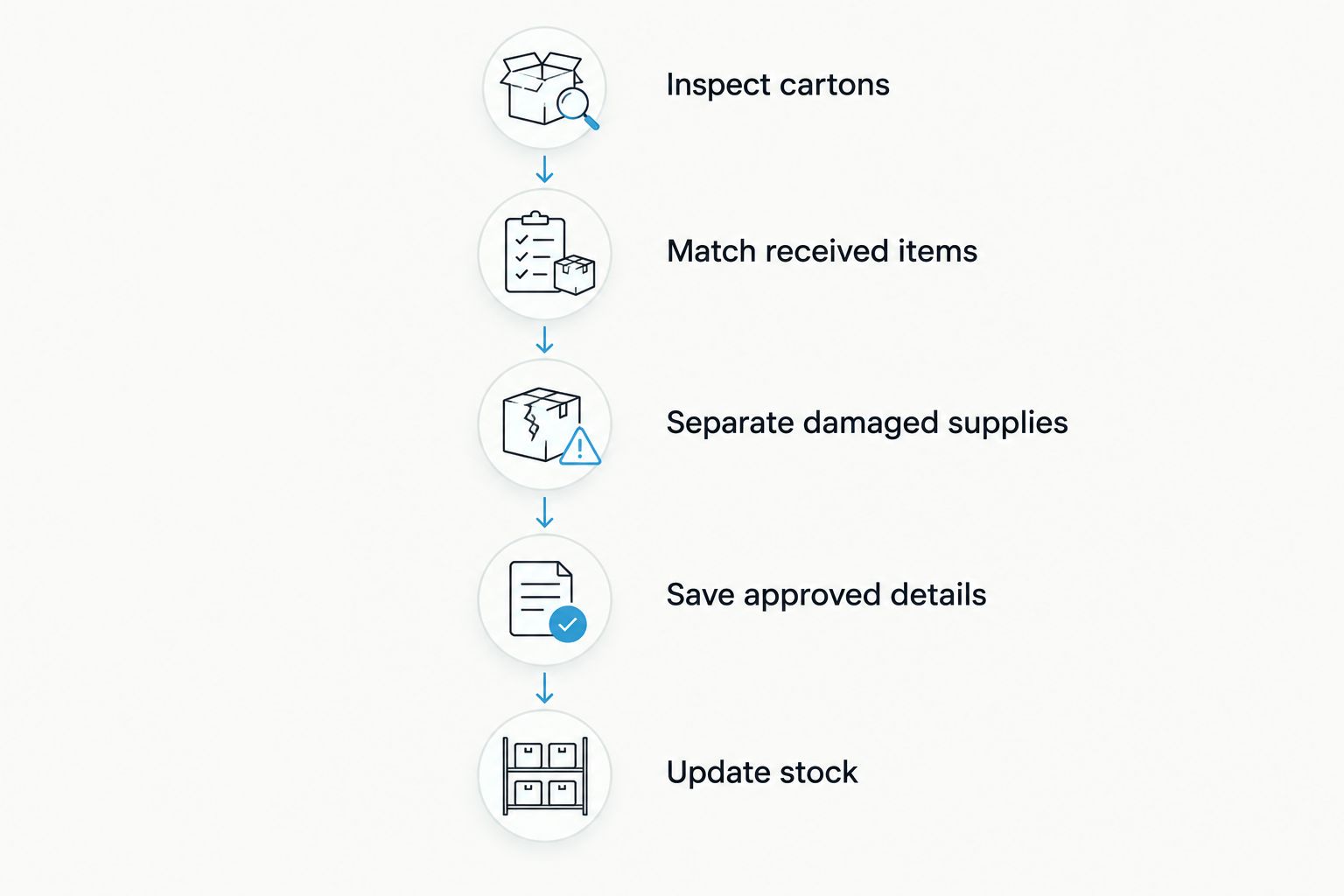
7. Set receiving and reorder rules before delivery
Decide who will inspect the order and what they will compare. Receiving should confirm the actual contents against the order record, not simply count cartons and put them away.
Start with a paper checklist or shared spreadsheet. Record the item received, quantity, closure match, visible condition, and any discrepancy. Follow your pharmacy's process for separating questionable supplies while an issue is resolved.
Make the next purchase easier by retaining the approved item details. You can also observe shelf use for 7 days as an initial check, then continue tracking until the record reflects your pharmacy's normal ordering cycle. That observation window is a planning choice, not a supplier delivery promise.
Close each order with these actions:
- Inspect cartons and contents at receipt.
- Match received items to the order confirmation.
- Separate damaged or incorrect supplies.
- Save approved item and variant details.
- Update stock and reorder records.
Compare purchasing options for your pharmacy
Choose the purchasing approach that fits the decision you are making. An established reorder, a packaging change, and a new supplier review need different checks.
The table compares approaches rather than competing retailers. Each has a practical use and a limitation; none replaces your pharmacy's responsibility to approve the packaging.
| Option | Best for | Main advantage | Key limitation |
|---|---|---|---|
| Reorder an approved item | Pharmacies keeping an established package | Builds on a documented item and workflow | Still requires checking current listing details and received contents |
| Evaluate a sample before changing | Pharmacies assessing unfamiliar packaging | Allows a hands-on fit and label check | Does not establish the contents or condition of a later shipment |
| Buy through FujiMochi | Independent buyers seeking a pharmacist-owned prescription-vial seller | Provides a store option focused in part on pharmacy packaging | Requires confirmation of current item details, terms, and fit for your pharmacy |
| Purchase a larger quantity after approval | Pharmacies with documented usage and storage space | Aligns purchasing with an established consumption record | Commits more shelf space and purchasing funds to the selected item |
Approve the package first; choose the order quantity second. A familiar supplier name does not correct a mismatched cap, an unclear carton quantity, or a label that does not fit.
Common mistakes independent pharmacy buyers make
Treating a cap description as a complete specification
A closure name does not answer every question about operation, compatibility, or documentation. Read the current instructions and verify the exact vial-and-cap combination before accepting it into your workflow.
Ordering from memory instead of the approved record
Descriptions such as small amber bottles leave room for a different selection. Save the exact item description, variant, and pack details so another staff member can repeat the order without guessing.
Filling shelf space with slow-moving sizes
A large carton is not automatically the right purchase. Base quantities on usable stock, observed consumption, storage space, and your purchasing schedule—not the space left in the cart.
Treating receipt as the end of the job
An unopened carton is not confirmed inventory. Check the contents, document discrepancies, and update the stock record before treating the delivery as ready for routine dispensing.
FAQ
What's the first thing to check when buying prescription vials wholesale?
Check the exact vial-and-cap combination against your pharmacy's dispensing requirements. Then confirm carton contents, label fit, documentation, and the complete order total before purchasing.
Does an amber prescription vial prove it meets every packaging requirement?
No. Amber color alone does not establish suitability for every prescription or packaging requirement. Check the manufacturer's information and follow your pharmacy's procedures for the specific use.
Can I assume reversible caps fit the vials I already have?
No. Confirm compatibility for the exact vial and closure before combining components. Similar appearance is not a substitute for manufacturer information or an approved pharmacy check.
How do I compare wholesale pharmacy supplies fairly?
Compare matching vial sizes, closure types, and confirmed usable quantities using the complete delivered order total. Include shipping and applicable charges, and verify whether caps are included.
Is FujiMochi a pharmacy supply seller or a supplement store?
FujiMochi sells both prescription-vial supplies and vitamins and supplements. Keep pharmacy packaging purchases separate from consumer supplement decisions, and confirm the current details on the relevant store page.
Should I test labels before changing prescription vials?
Yes. Test your normal label stock on the proposed vial and inspect text, placement, adhesion, and any barcode scan. Use test information rather than patient information during the purchasing review.
What should I save to make prescription-vial reordering easier?
Save the approved item description, selected variant, vial size, closure type, carton contents, and order confirmation. Add receiving notes so the next buyer knows what was accepted and what needs another check.
One last thing
Keep the approved packaging specification beside the reorder record, not only in someone's memory. Include a clear photo without patient information if your pharmacy's procedures permit it. For 2026 purchasing, that small step gives a first-time buyer a concrete reference and gives an experienced buyer a reason to notice when a listing or shipment changes.

