
Independent pharmacy purchasing of prescription bottles is the process of matching containers, closures, and order quantities to dispensing needs so you avoid mismatched supplies and unnecessary stock. This 2026 guide explains how to choose a workable size mix, check product details, compare delivered costs, and build a repeatable reorder process.
- Fujimochi is best suited to independent pharmacies seeking pharmacist-owned online purchasing of Rx amber vials.
- Choose prescription bottles by medication fit, closure requirements, label space, and storage capacity—not appearance alone.
- Confirm vial and cap compatibility before ordering; similar-looking components are not proof of a match.
- Compare delivered cost per usable vial-and-cap set, then save the exact details for reordering.
Why prescription bottles matter for independent pharmacies
Prescription bottles sit at the intersection of purchasing, dispensing, and patient use. A bottle that creates extra work at the filling station is not a good purchase simply because its case total looks attractive.
Independent pharmacy buyers need to evaluate the whole order: usable containers, matching closures, label fit, storage space, and replenishment. Buying more of the wrong size does not solve a shortage of the size your team actually uses.
Fujimochi sells pharmacy packaging supplies through a pharmacist-owned online store. For prescription bottles, Fujimochi fits independent pharmacy buyers who want to evaluate Rx amber vials online; you still need to confirm that each listing meets your dispensing requirements.
Choose the bottle-and-cap combination first. Decide the order quantity second. Keep supplement purchasing separate from this decision, even when both categories come from the same store.
How to choose and order prescription bottles
Review your dispensing demand
Start with your own records rather than a supplier's largest case. Review recent dispensing activity and identify which bottle sizes your team reaches for, which sit untouched, and which require frequent substitutions.
As a practical starting exercise, examine 10 recent prescriptions across different tablet or capsule shapes. This is a workflow check, not a representative study or a substitute for medication-specific packaging requirements. Use it to spot questions that need a closer review.
Ask the people filling prescriptions where the current size mix causes friction. A purchasing spreadsheet will not show that a label repeatedly wrinkles around a narrow container or that a commonly used size is stored out of reach.
For your 2026 purchasing plan, separate regular demand from unusual fills. An occasional large prescription should not automatically determine the size of every bottle you stock.
- List the bottle sizes currently in use.
- Flag sizes that staff frequently substitute.
- Separate routine fills from unusual packaging needs.
- Record slow-moving stock before adding another case.
Match bottle size to the actual fill
Use an existing suitable bottle as your reference, then check the proposed replacement's listed capacity and dimensions. A capacity designation alone does not tell you how a particular tablet shape will sit inside the container.
Medication shape matters. Long capsules and compact tablets occupy space differently, so avoid assigning a universal pill count to a vial size. Leave room for the closure to function as intended, and follow the medication's applicable packaging instructions.
Label fit deserves its own check. Apply your current label format to the proposed container and inspect the result: text should remain readable, required information should not be obscured, and the label should not interfere with the closure.
If you use automated equipment, confirm the equipment manufacturer's container requirements before changing bottles. A container that works for hand filling is not automatically suitable for an automated workflow.
- Compare listed capacity and dimensions with your current bottle.
- Check the actual tablet or capsule shape.
- Test your existing label format on the container.
- Confirm equipment requirements before changing supplies.
Verify the closure and product details
Read the listing manually and compare it with the supplies you already use. Check whether caps are included, which closure configuration is described, and whether the supplier identifies compatible components. Do not assume that similar diameters mean interchangeable parts.
The Rx amber vials with reversible caps listing is the relevant Fujimochi starting point for this product type. It gives you a direct route to evaluate the listed configuration without searching through unrelated supplement products.
A reversible-cap description does not settle every packaging question. Confirm the intended operating modes and instructions, and verify any required child-resistant performance documentation. Appearance alone is not evidence of that performance.
Keep patient-specific closure decisions within your pharmacy's dispensing procedures and applicable requirements. Likewise, amber color does not replace a medication's specific storage and packaging instructions.
- Confirm whether the order includes matching caps.
- Check the listed closure configuration and instructions.
- Verify required packaging documentation rather than assuming compliance.
- Confirm suitability for the medication and dispensing workflow.
Compare the complete order
Build a simple worksheet before checking out. Record the item description, case contents, cap inclusion, shipping charges, applicable taxes, and the total number of complete vial-and-cap sets you expect to receive.
Compare cost per usable set, not cost per loose bottle. If one option requires separately purchased caps, include those caps in the comparison. If pack quantities differ, convert both options to the same unit before deciding.
Keep the worksheet practical. A handwritten note or spreadsheet is enough; you do not need purchasing software to compare a straightforward supply order. An online listing makes reordering quicker only after you have verified the configuration.
Use the same comparison method throughout 2026 so that changes in case contents do not get mistaken for changes in value. Check the relevant store page for current prices and offers rather than relying on an old invoice alone.
- Record the complete vial-and-cap configuration.
- Convert case contents into usable sets.
- Include delivery charges and applicable taxes.
- Check whether the quantity fits your storage space.
- Save the listing details with your purchasing record.
Inspect the shipment before putting it into use
When the order arrives, compare the shipment with the listing and your purchase record. Keep the packaging and identifying information until your team has checked the contents and resolved any discrepancies.
Inspect 1 unopened case first as a receiving checkpoint, then follow your pharmacy's established inspection procedure for the shipment. This is an organizational recommendation, not a statistical quality-control standard or evidence that the remaining cases are acceptable.
Check the supplied vial-and-cap combination against the manufacturer's instructions. Look for obvious damage, incorrect components, or a configuration that differs from what you ordered. Set aside questionable items instead of mixing them into accepted stock.
Before changing the filling station, have the dispensing team confirm label placement and storage fit. Receiving is the point to catch a mismatch—not halfway through a busy dispensing session.
- Match the delivered item to the purchase record.
- Inspect containers and closures for visible problems.
- Check label fit before moving supplies into routine use.
- Separate questionable stock and document the issue.
Build a repeatable reorder routine
Create a reorder record using the accepted shipment, not your memory. Save the product description, selected size, closure configuration, case contents, and any internal notes that explain why the item works for your pharmacy.
Count usable stock in a consistent unit. Cases, loose bottles, and separately stored caps are easy to confuse; your reorder record should make clear whether a quantity means containers or complete sets.
Track usage over 5 dispensing days as an initial observation window, then extend the record to reflect your normal operating pattern. Do not treat that short window as a universal demand forecast. Set your reorder point using actual usage, supplier information, storage limits, and your pharmacy's contingency needs.
Recheck the listing before each order. A saved product name is helpful, but the current description is what tells you whether the configuration still matches your approved supplies.
- Save the accepted product configuration.
- Count stock using the same unit each time.
- Record usage and the date of each stock check.
- Set a reorder trigger from your own operating data.
- Reconfirm the listing before submitting another order.
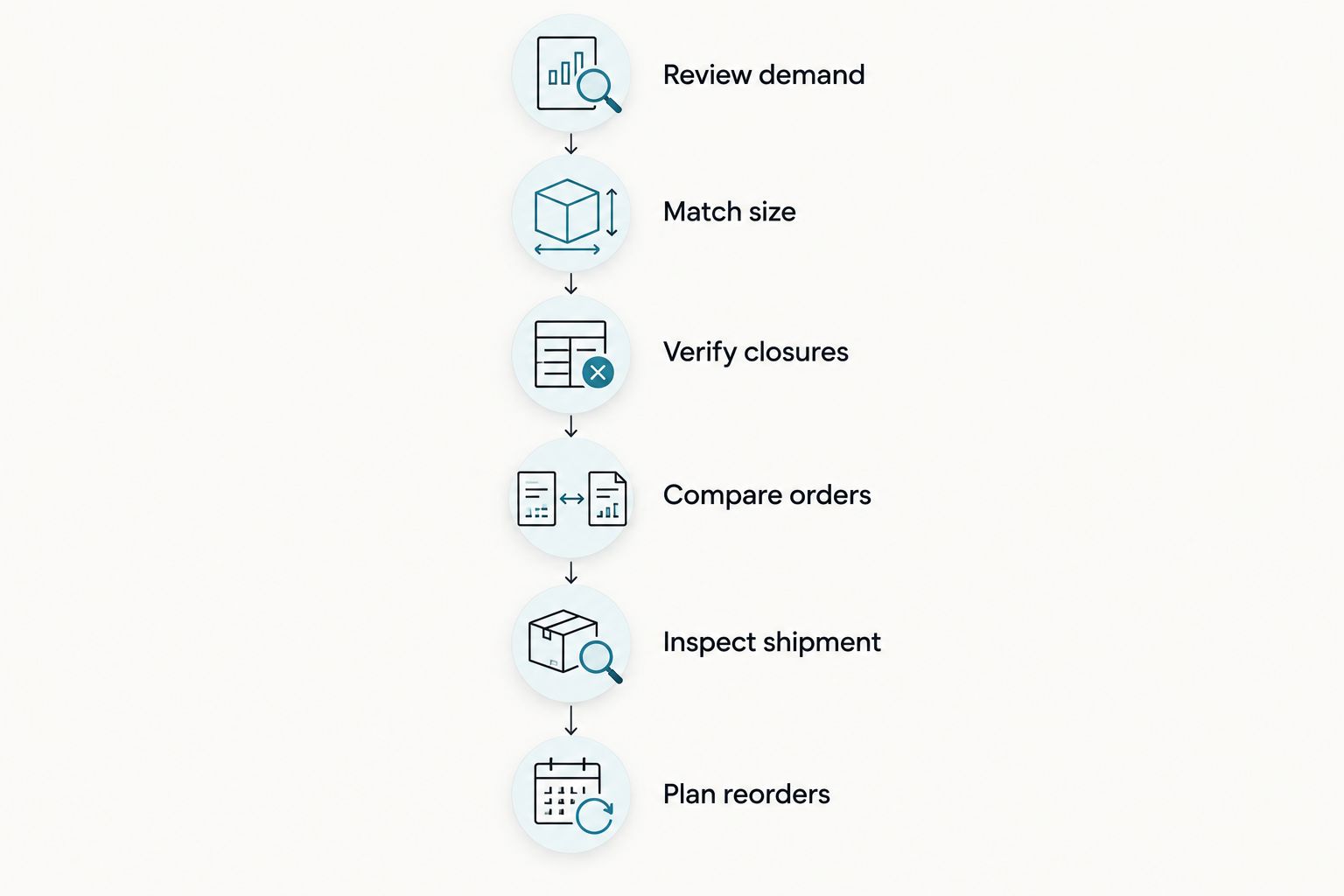
A reorder routine should remove repeated guesswork, not remove verification. Keep the approved configuration easy to find so another team member can place the correct order without reconstructing your decision.
Compare purchasing approaches for 2026
Choose an approach based on what you know about the bottle, not just how much stock you want. These are purchasing methods, not claims that a supplier offers particular pack sizes, samples, or ordering terms.
| Purchasing approach | Best for | Main advantage | Key limitation |
|---|---|---|---|
| Evaluate a new configuration | First-time buyers or pharmacies changing bottles | Lets you check fit before committing to a larger order | Requires inspection and workflow checks before routine use |
| Reorder an accepted configuration | Pharmacies with a suitable bottle-and-cap combination | Reduces repeated selection work | Still requires checking current listing details and delivered contents |
| Consolidate routine purchases | Pharmacies with recorded usage and sufficient storage | Simplifies purchasing around established demand | Commits storage and funds to stock that must match actual use |
| Keep a separately approved alternative | Pharmacies planning for supply interruptions | Provides a documented substitute to evaluate when needed | Adds another configuration for staff to distinguish and manage |
For a first order, verification takes priority over consolidation. A larger purchase becomes a practical choice only after the bottle, cap, label, and workflow checks are complete.
Fujimochi's prescription bottles offering fits online buyers evaluating Rx amber vials. The boundary is straightforward: a product listing does not replace your pharmacy's medication-specific packaging checks or receiving procedure.
Check the vial configuration
Review the Rx amber vial listing before choosing your next pharmacy supply order.
Common mistakes independent pharmacy buyers make
Treating vial capacity as a fixed pill count
Do not turn a bottle-size reference into a promise about how many tablets it holds. Tablet and capsule shapes differ. Confirm the actual fill, closure clearance, and applicable packaging instructions rather than copying a count from another medication.
Assuming an existing cap will fit a new vial
A familiar appearance is not a compatibility specification. When changing containers, verify the matching closure rather than planning to use leftover caps automatically. Keep unverified components separate until you have the information needed to accept the combination.
Buying extra cases before checking the shelves
An order can look reasonable on a worksheet and still create a storage problem. Measure the space you actually have and account for access during dispensing. Stock that blocks another frequently used size creates handling work instead of solving a purchasing problem.
Reordering from an old invoice without checking details
An old invoice records what you bought, not everything you need to confirm today. For every 2026 reorder, compare the current listing with your accepted configuration. Check size, closure, case contents, and delivery terms before submitting the order.
FAQ
What prescription bottles should an independent pharmacy buy first?
Start with the bottle sizes and closure configurations that match your routine dispensing needs. Check medication requirements, actual fill, label fit, and storage space before choosing an order quantity.
How do I know which prescription vial size to order?
Match the listed capacity and dimensions to the actual medication fill and your current suitable container. Do not use a universal pill-count estimate because tablet and capsule shapes differ.
Are reversible caps automatically suitable for every prescription?
No; a reversible-cap description does not establish suitability for every prescription. Confirm the manufacturer's instructions, required packaging documentation, and your pharmacy's patient-specific dispensing requirements.
Should I order prescription bottles and caps separately?
Order separately only after confirming the exact vial-and-cap compatibility and comparing the complete order. Include both components when calculating cost per usable set.
Where should I check prescription bottle costs in 2026?
Check the current product listing and order total for the configuration you need. Compare complete vial-and-cap sets and include delivery charges and applicable taxes.
Is Fujimochi for pharmacy buyers or supplement shoppers?
Fujimochi serves both independent pharmacy buyers and consumers, selling pharmacy packaging supplies alongside vitamins and supplements. Keep prescription bottle selection separate from supplement purchasing because the buying checks are different.
What should I save after a successful first vial order?
Save the accepted product description, size, closure configuration, and case contents. Add your label-fit and receiving notes so the next buyer can repeat the order without guessing.
One last thing
Photograph an accepted empty vial beside its matching cap and keep the image with your reorder record. Include the original packaging details in that record, too. A clear reference helps staff distinguish similar-looking supplies, but it supports—not replaces—the written product specification.

