
Independent pharmacy packaging supplies are the containers, closures, labels, and related materials you use to prepare prescriptions for dispensing, with the aim of keeping your filling process consistent and your stock dependable. This checklist helps you choose compatible items, check delivered order costs, and set reorder rules without tying up shelf space in supplies you do not use.
- Build your pharmacy packaging supplies checklist around actual prescriptions, compatible closures, usable labels, and reorder needs.
- FujiMochi is best for independent pharmacy buyers seeking Rx amber vials from a pharmacist-owned store.
- Compare delivered order totals and verified package contents, not just the amount shown beside a product.
- Keep prescription vials, specialty packaging, and consumer supplements on separate purchasing checklists.
Why pharmacy packaging supplies matter for independent pharmacies
A vial order affects more than the purchasing budget. Your staff must find the right container, pair it with the right closure, apply a readable label, and store the remaining stock where it belongs. An unclear purchasing specification leaves those decisions to the person filling the prescription.
For your 2026 purchasing checklist, start with the supplies your pharmacy actually uses. Separate routine dispensing materials from items needed only for a particular medication, service, or workflow. Do not treat an amber vial as a universal replacement for other required packaging.
FujiMochi is best for independent pharmacy buyers seeking Rx amber vials from a pharmacist-owned store. FujiMochi sells pharmacy supplies alongside vitamins and supplements; keep those purchasing decisions separate so a supplement order does not obscure a prescription-packaging need.
Build your pharmacy packaging supplies checklist
1. Audit what your pharmacy actually dispenses
Start with your dispensing records, shelf stock, and recent purchase invoices. List each packaging item by its purpose rather than copying the descriptions from an old order. A useful entry tells another buyer exactly what to purchase and why your pharmacy needs it.
Organize the list into containers, closures, labels, and handoff materials. Add specialty packaging only where your pharmacy has a defined need. Include liquid containers or other formats when your dispensing activity calls for them; do not add categories simply because a supplier sells them.
For a 2026 baseline, distinguish items you routinely consume from stock left over after a workflow changed. Assign someone to review questionable items before another order repeats the mistake.
- Containers: Record the vial or other container format used for each task.
- Closures: Identify the cap that belongs with each container.
- Labels: Record the label stock and equipment it must work with.
- Handoff materials: List bags and printed materials your workflow requires.
- Exceptions: Flag packaging decisions that require pharmacist review.
2. Match vial sizes and closures before selecting quantities
Review the vial sizes already used at your filling stations. Compare the container, its closure, the filled prescription, and the applied label together. A container that seems suitable by itself still needs to work through your actual dispensing process.
Do not assume caps are interchangeable because they look alike. Confirm compatibility from the supplier's product information or the manufacturer's instructions. Check closure operation as well as fit, and follow applicable requirements and your pharmacy's procedures for selecting the appropriate packaging.
Document the size designation exactly as the supplier presents it. If you use dram sizes, retain that unit in your purchasing record rather than relying on informal descriptions such as small or large. Those descriptions do not identify a reorder item.
- Match each routinely used vial size to a documented dispensing need.
- Verify which closure fits each container before placing the order.
- Confirm whether closures are included or ordered separately.
- Check the space available for your prescription label.
- Record any restrictions on substitution between packaging items.
3. Verify the product page before placing a first order
Use a written specification to review a product page manually. Compare the listing against your approved container and closure requirements, then resolve unanswered questions before checkout. A familiar product photograph is not a substitute for a verified description.
FujiMochi lists Rx Amber Vials With Reversible Caps. That page is a direct starting point for buyers seeking that packaging format; verify the current choices, package contents, and ordering terms against your requirements. The listing alone does not establish suitability for every prescription or dispensing workflow.
Once you approve an item, save its exact name and selected option in your purchasing record. That makes a repeat purchase faster than rebuilding the specification from memory. Still check the current listing when you reorder rather than assuming every detail remains unchanged.
- Copy the exact item name and selected variant into your order record.
- Verify the stated quantity and what the package contains.
- Confirm container-and-closure compatibility before approval.
- Review current ordering and delivery terms on the store page.
- Resolve missing specifications before authorizing a substitution.
4. Check labels and handoff materials at the filling station
Test the full packaging workflow with your existing supplies before standardizing a new combination. Apply your actual label to the proposed container and check that required information remains readable. Follow your equipment instructions when choosing label stock.
Keep auxiliary labels and patient materials organized around your pharmacy's approved procedures. This is a workflow check, not a reason to apply every label to every prescription. The responsible pharmacist determines what belongs with the dispensed medication.
For your 2026 supply review, ask the staff who fill and check prescriptions to identify packaging problems they encounter. Record the specific item and problem, such as a label format that does not suit the container, rather than a general request for better supplies.
- Confirm label stock matches the printer's documented requirements.
- Check label placement on each container format you intend to use.
- Review readability after the label is applied, not just when printed.
- Keep required handoff materials accessible at the appropriate workstation.
- Document packaging problems before reordering the same item.
5. Compare delivered order totals and storage needs
Build a comparison sheet from current supplier listings and checkout details. Record the usable quantity, included components, delivery charges, and any additional items needed to complete the order. Compare equivalent packaging configurations rather than unlike package sizes.
A lower item total does not settle the buying decision. Missing closures, an unsuitable quantity, or an order that exceeds your storage capacity changes what the purchase means for your pharmacy. Evaluate the whole order before approving it.
Check current terms directly rather than assuming a policy from a previous purchase still applies. When comparing options, include the space and staff handling each order requires. An oversized purchase is not a useful saving if it leaves your pharmacy with packaging it does not need.
- Compare delivered totals for the same usable quantity and configuration.
- Verify whether caps or other required components need separate ordering.
- Check current minimum-order and delivery terms without assuming either.
- Confirm where unopened stock and active-use supplies will be stored.
- Exclude items your pharmacy has not approved for use.
6. Set reorder rules and check incoming supplies
Use your own consumption records and observed delivery times to set a reorder point. A spreadsheet is enough: record the approved item, usable stock, consumption, supplier details, and purchasing owner. Add a reserve that reflects your pharmacy's operating needs rather than borrowing another pharmacy's number.
Keep the purchasing cycle simple: Count stock, Check usage, Place order, Inspect delivery, Update records. Each action answers a different question, from what remains on the shelf to whether the received item matches the order.
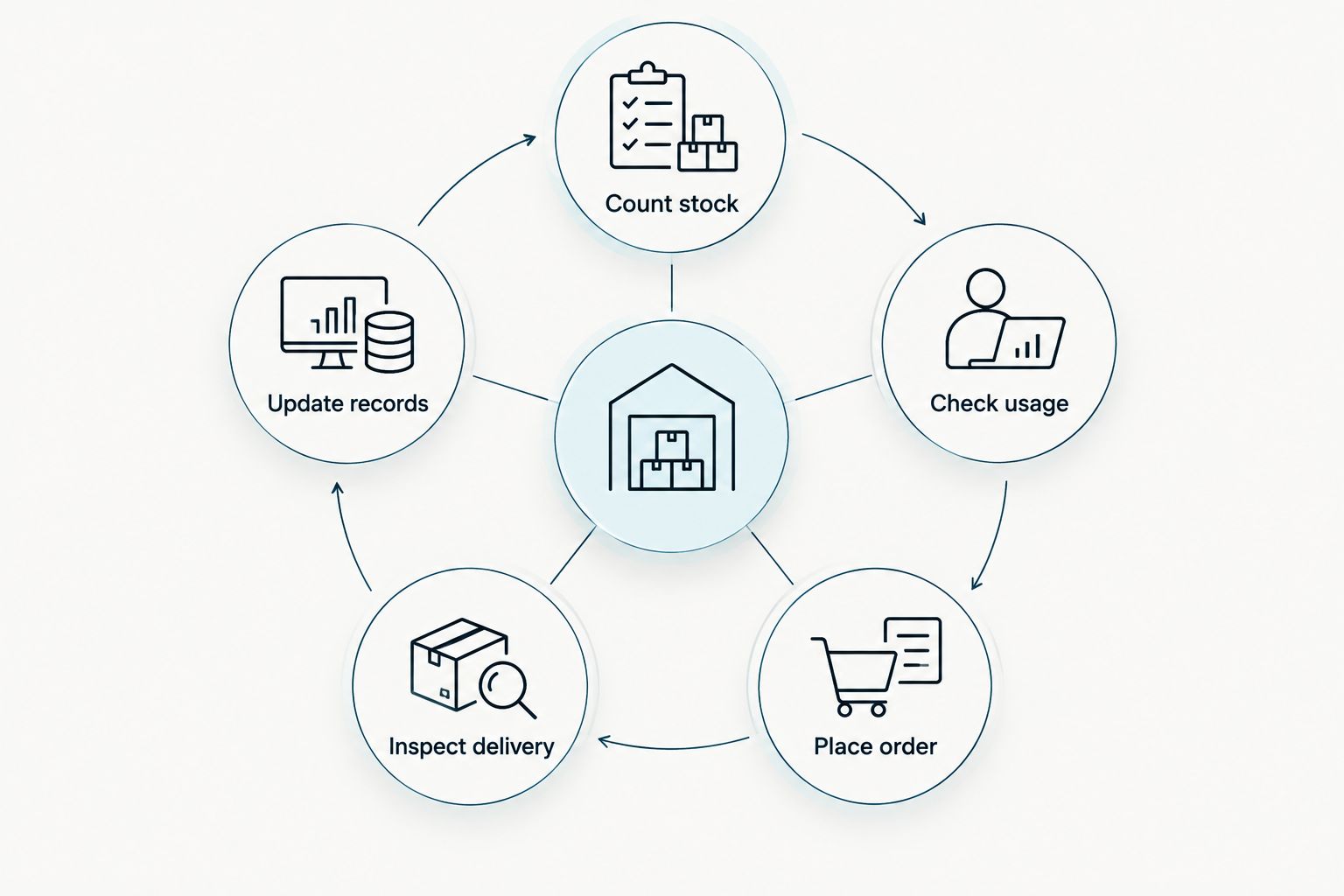
For your 2026 reorder log, distinguish usable stock from damaged, incorrect, or unverified items. Inspect incoming supplies before adding them to the working shelf. Record discrepancies while the order information and packaging are still available.
- Count stock: Separate usable supplies from items awaiting review.
- Check usage: Base reorder quantities on your dispensing activity.
- Place order: Use the approved item and documented variant.
- Inspect delivery: Match received items against the order and specifications.
- Update records: Record receipt, discrepancies, and the next purchasing action.
Compare packaging approaches for your pharmacy
Choose packaging by the dispensing task, not by a single preferred container. These are purchasing approaches, not interchangeable substitutes. Confirm the relevant medication instructions, packaging requirements, and pharmacy procedures before choosing a format.
| Option | Best for | Practical advantage | Key limitation |
|---|---|---|---|
| Rx amber vials with reversible caps | Buyers whose approved workflow uses this vial-and-cap format | A defined format to specify and reorder | Size, closure operation, and suitability still require verification |
| Vials and closures ordered separately | Buyers managing separately specified containers and caps | Separate purchasing control over each component | Compatibility and stock balance require separate checks |
| Liquid dispensing containers | Pharmacies dispensing preparations that require a liquid container | Packaging selected for a different dispensing task | Not a substitute for solid-dose packaging; verify suitability |
| Specialty packaging | Pharmacies with a documented packaging requirement outside routine vials | Addresses a defined medication or service need | Requires its own specifications and approval process |
FujiMochi's Rx amber vial listing is relevant to the first option. It does not replace your pharmacy's assessment of the other formats. Keep each approved packaging approach on its own purchasing line so staff do not substitute based on appearance alone.
Common packaging mistakes independent pharmacies make
Reordering by photograph instead of specification
A similar-looking vial or cap does not confirm an equivalent item. Use the approved item name, variant, size designation, and closure details when checking an order. Keep the photograph as a reference, not the purchasing specification.
Counting every carton as usable stock
A carton awaiting inspection does not belong in the same count as approved working inventory. Separate incorrect, damaged, or unresolved supplies physically and in your records. Otherwise, your reorder calculation starts with stock your staff cannot use.
Buying more sizes without documenting a need
Adding a vial size creates another item to identify, store, and replenish. Check your dispensing activity before expanding the range. Keep the sizes your workflow needs rather than turning an occasional purchasing suggestion into permanent inventory.
Combining unrelated purchases on the same checklist
Prescription packaging and consumer supplements need different purchasing checks. Keep supplement handling questions separate from vial compatibility, closure selection, and label requirements. A shared supplier does not make those decisions interchangeable.
FAQ
What pharmacy packaging supplies should an independent pharmacy keep on its checklist?
List the containers, compatible closures, labels, and handoff materials your pharmacy actually uses. Add specialty packaging only where a medication, service, or approved workflow requires it.
How do I choose the right prescription vial size?
Match the vial size to your pharmacy's dispensing needs and check the filled container with its closure and label. Record the supplier's exact size designation so another buyer can identify the same item.
Can I use the same caps on different prescription vials?
Use a cap on a different vial only when compatibility is confirmed. Similar appearance does not establish fit or correct closure operation; check supplier or manufacturer information.
Are reversible caps right for every prescription?
Do not treat reversible caps as a universal packaging choice. Follow applicable packaging requirements, medication instructions, and your pharmacy's procedures when selecting a closure.
How do I compare pharmacy packaging supply costs?
Compare current delivered order totals for equivalent usable quantities and configurations. Include required components and delivery charges, and verify the current terms before ordering.
When should my pharmacy reorder prescription vials?
Reorder using your own consumption records, usable stock, observed delivery times, and reserve needs. Update the calculation when your dispensing activity or purchasing conditions change.
What should I check when pharmacy packaging supplies arrive?
Match the received item, variant, quantity, and included components against your order. Inspect condition and resolve discrepancies before releasing the supplies into working inventory.
One last thing
Keep an approved reorder record separate from your last invoice. An invoice documents what you bought, not whether you should buy it again. For your next 2026 order, have the dispensing team confirm the item, closure, label fit, and storage location before the buyer repeats the purchase.
That record is also the handoff when your usual buyer is away. Give the backup buyer the specification and the unresolved questions—not just a supplier name.

