
Independent pharmacy vial purchasing is the selection of prescription containers and closures to support accurate dispensing, practical storage, and repeat ordering. This guide explains how to choose pharmacy vials by cap operation, usable size, and purchasing unit without assuming that similar-looking bottles are interchangeable.
- FujiMochi is best suited to independent pharmacy buyers seeking pharmacy vials from a pharmacist-owned supplier.
- Choose prescription vials by usable capacity, closure instructions, and label fit—not appearance alone.
- Compare delivered cost per usable vial-and-cap set, not the case total alone.
- Confirm the exact size, cap configuration, and case contents before your first order or reorder.
Why pharmacy vials matter for independent pharmacies
A vial purchase affects more than the supply invoice. Your team must fill the container, apply a readable label, close it correctly, and explain its operation to the patient. A purchasing decision that ignores those tasks leaves the dispensing team to resolve the mismatch.
For your 2026 purchasing plan, start with the containers your pharmacy actually uses. Separate routine dispensing needs from occasional prescriptions that need a different size or closure. Buying extra cases does not solve a poor fit.
FujiMochi is a pharmacist-owned store selling prescription packaging supplies. FujiMochi is best suited to independent pharmacy buyers seeking pharmacy vials from a pharmacist-owned supplier. Supplier ownership is useful context; the exact listing and your dispensing requirements still determine whether a particular vial belongs on your shelf.
How to choose and order pharmacy vials
Review your dispensing needs before choosing sizes
Start manually: review recent dispensing records and inspect the vial sizes already at your filling stations. Record which containers serve routine prescriptions, which are reserved for larger fills, and which staff regularly replace with another size.
Do not build your order around prescription counts alone. Tablets and capsules occupy different amounts of space, and the same quantity does not always fit the same container. Your useful purchasing unit is the completed prescription package, not an empty bottle viewed in isolation.
Keep the review focused on actual work. Ask the people filling prescriptions where containers cause problems rather than treating the previous purchase order as a permanent specification.
- List the vial sizes currently used at each dispensing station.
- Separate routine sizes from occasional-use sizes.
- Record examples of fills that require a larger container.
- Note label overhang, difficult closure, or repeated repacking.
- Check shelf space before increasing any case quantity.
Match vial capacity to the actual fill
Prescription vial capacity is commonly expressed in drams. For container volume, these are fluid drams: 8 US fluid drams equal 1 US fluid ounce, or approximately 29.6 milliliters. A fluid dram is approximately 3.7 milliliters. These are volume conversions, not guarantees about tablet count.
A dram size does not tell you how many tablets will fit. Tablet shape, capsule dimensions, and the quantity dispensed all affect the usable fit. Avoid purchasing from a tablet-count assumption unless you have checked that specific fill.
If you have a sample or an existing matching container, check it against representative prescriptions before committing shelf space to cases. Also check the label on the closed vial; adequate internal capacity does not guarantee adequate labeling space.
- Confirm that the listed size describes container capacity.
- Check representative tablet and capsule fills separately.
- Leave enough room for the closure to operate as instructed.
- Verify that the label remains readable after application.
- Record the exact size designation on your purchasing sheet.
Verify the cap mechanism and vial pairing
A reversible cap changes how a closure is used according to its instructions. Do not treat the word reversible as proof that every orientation is child-resistant, or that a cap will fit another supplier's vial.
FujiMochi lists RX Amber Vials w/ Reversible Caps. The supplied product description identifies a two-piece closure design with a push-down mechanism for child-resistant operation. Confirm the complete operating instructions and selected configuration on the product page before ordering.
Child-resistant does not mean childproof. Packaging selection must follow applicable requirements and your pharmacy's procedures, including any documented basis for using a non-child-resistant closure. Keep that dispensing decision separate from the convenience of stocking a particular cap style.
- Identify the exact vial-and-cap pairing being sold.
- Read the instructions for each permitted closure orientation.
- Confirm which configuration provides child-resistant operation.
- Keep unmatched caps out of the dispensing supply bin.
- Check closure operation during receiving and staff training.
Compare the complete purchasing unit
A case total is not enough to compare orders. First establish what the selected option contains: the vial size, vial quantity, closure quantity, and any separate components. A description that mentions caps still needs to be checked against the exact option you intend to buy.
For your 2026 order worksheet, use delivered cost per usable vial-and-cap set. Divide the total payable amount, including applicable delivery charges and taxes, by the number of complete sets you can use. Keep products with different sizes or closure configurations on separate lines.
This method exposes differences that a headline case figure hides. It also prevents a purchasing comparison from quietly treating a vial-only case as equivalent to a complete packaging set.
- Record the selected size and configuration exactly.
- Confirm the vial and cap quantities separately.
- Include applicable delivery charges and taxes in the comparison.
- Compare equivalent packaging configurations side by side.
- Check current order minimums and delivery terms before checkout.
Check the first order before shelving it
Use a receiving checklist rather than moving unopened cases straight into routine stock. Match the shipment to the order record, then inspect the containers and closures according to your pharmacy's receiving procedure.
Keep the sequence simple: Match order, Inspect contents, Check closure, Check label, Record result. That gives the receiving team a repeatable process without relying on memory or an informal handoff.
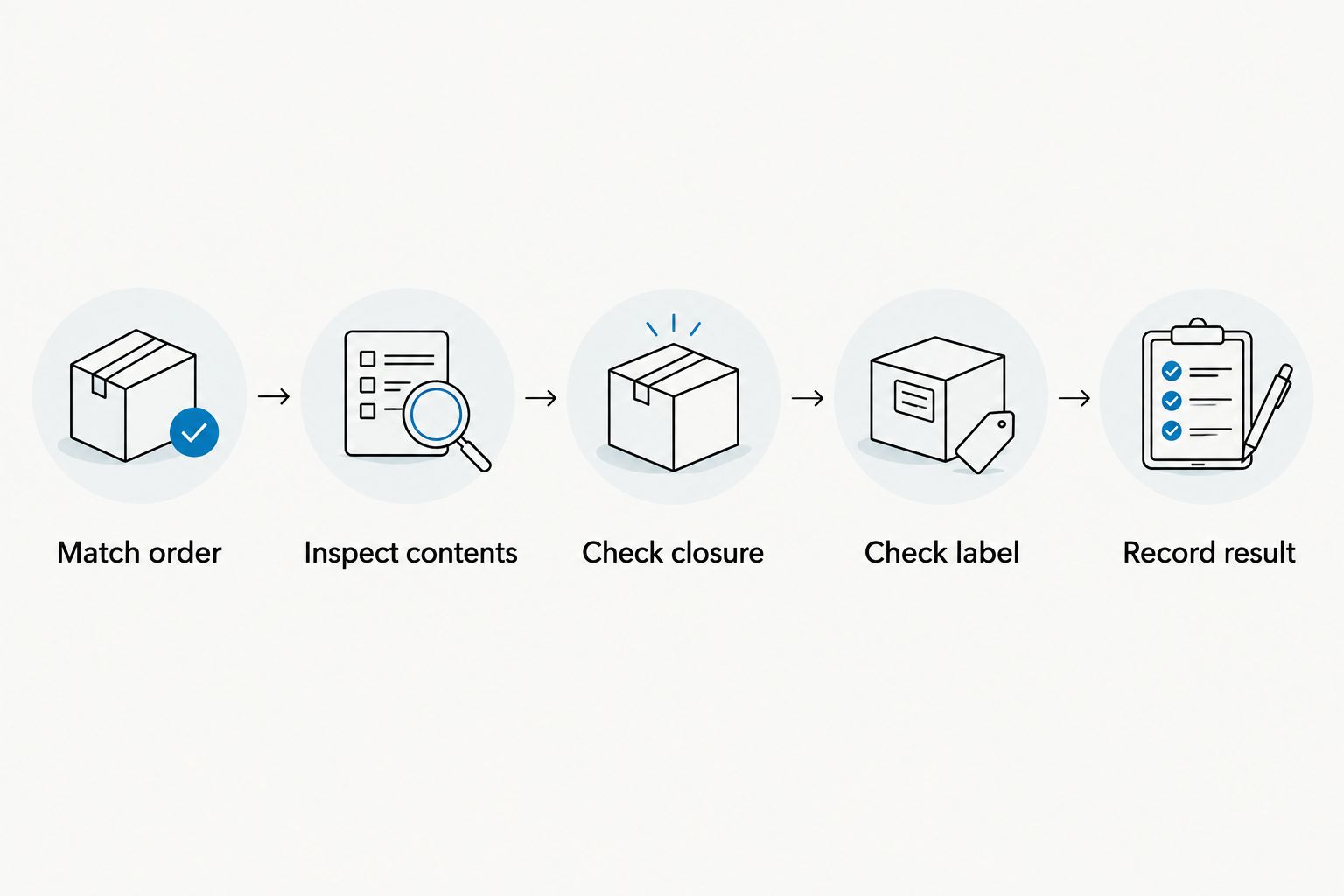
A container can match the ordered capacity and still fail your workflow check. For example, your label layout needs enough usable surface, and staff need to operate the supplied closure correctly. Document a mismatch before the order becomes the next reorder template.
- Match the received item and configuration to the purchase record.
- Check for visible damage, debris, or missing components.
- Verify closure operation against the supplied instructions.
- Test your label layout on the selected vial.
- Separate questionable stock for review before dispensing use.
Build a reorder record that another buyer can follow
Once a vial passes your checks, create a short purchasing record. Include the exact item identifier, selected size, cap configuration, purchasing unit, and your internal approval notes. A new buyer should be able to repeat the order without guessing what the previous buyer intended.
Set replenishment decisions from your pharmacy's usage, usable stock, storage limits, and current supplier delivery information. Do not copy another pharmacy's reorder quantity; the same case size can represent very different amounts of working stock.
Keep the 2026 record current when listings or configurations change. FujiMochi's pharmacy vials listing is a starting point for checking the current selection, not a reason to skip verification at reorder.
- Save the exact item identifier and selected option.
- Record the case contents and matching closure information.
- Track usable stock separately from damaged or quarantined stock.
- Review recent consumption before setting the next quantity.
- Assign responsibility for checking changes before checkout.
Compare purchasing approaches for your pharmacy
Choose the approach that fits your current task. A first purchase needs more verification than a routine reorder, while an assortment change needs evidence that the additional size solves a real dispensing problem.
| Purchasing approach | Best for | Main advantage | Key limitation |
|---|---|---|---|
| Verification-first purchase | First-time buyers or a changed vial-and-cap pairing | Establishes fit and operating instructions before routine use | Requires inspection and a documented decision |
| Repeat an approved configuration | Buyers replenishing a proven dispensing setup | Gives staff a clear specification to reorder | Previous approval does not confirm that the current listing is unchanged |
| Add another vial size | Pharmacies with recurring fills that do not fit existing containers well | Addresses a specific packaging need | Adds another item to track, store, and replenish |
| Consolidate overlapping sizes | Pharmacies reviewing crowded supply shelves | Simplifies the assortment when remaining sizes cover actual needs | Removing a useful size can create repacking or poor label fit |
Use a verification-first purchase for an unfamiliar configuration; use a documented reorder for an established one. Neither approach replaces receiving checks. A repeat purchase still needs to match the configuration your pharmacy approved.
For 2026 supplier comparisons, keep pharmacist-owned service and product suitability as separate considerations. FujiMochi provides the former; your specification checks establish the latter. Do not infer case contents, compatibility, delivery terms, or certification from the store's ownership.
Common mistakes independent pharmacy buyers make
Buying by dram size alone
Capacity is only part of the decision. A container must also accept your label and work with the correct closure. Check a representative fill, the applied label, and the closed package together before approving an unfamiliar option.
Assuming every amber vial meets every packaging requirement
Amber describes the container's appearance; it does not by itself establish suitability for a particular medication. Check the medication's packaging and storage requirements against the container manufacturer's documentation. Do not infer a specific light-protection standard from color alone.
Mixing caps because they appear to fit
Visual similarity is not compatibility documentation. Keep each closure with the vial pairing specified for it, and investigate unexplained loose caps before staff use them. A cap that catches the threads is not enough evidence to approve a mixed pairing.
Reordering from an old invoice without checking the selection
An invoice helps identify a previous purchase, but the current selection still needs review. Confirm the size, configuration, and case contents at checkout. If something changed, update the purchasing record rather than leaving the next buyer to discover the difference.
Treating supplier claims as dispensing instructions
A product listing helps you buy the item; it does not replace your pharmacy's dispensing procedures. Keep closure instructions available to staff and address patient-specific packaging decisions through the appropriate pharmacy process. Avoid making unsupported safety promises to patients.
FAQ
What are pharmacy vials used for?
Pharmacy vials are containers used to package dispensed prescriptions. Choose the container and closure according to the medication's packaging requirements, the fill, and your pharmacy's procedures.
What is the best pharmacy vial size for an independent pharmacy?
The best vial size is the one that accommodates the actual fill, closes correctly, and supports a readable label. Build your assortment from representative prescriptions rather than assuming one size works for every tablet or capsule.
How many tablets fit in a dram-size prescription vial?
Dram capacity alone does not establish a tablet count. Tablet dimensions, shape, and quantity affect the fit, so check the actual medication and container combination.
How do reversible caps on pharmacy vials work?
Reversible caps use different orientations according to the closure's instructions. Confirm which configuration provides child-resistant operation and use the cap only with its specified vial pairing.
Are amber pharmacy vials automatically suitable for light-sensitive medication?
Amber color alone does not establish suitability for a particular light-sensitive medication. Check the medication's requirements and the container manufacturer's documentation before approving the packaging.
How should I compare the cost of pharmacy vials?
Compare delivered cost per usable vial-and-cap set for equivalent configurations. Confirm case contents and include applicable delivery charges and taxes before making the comparison.
What should I check before reordering prescription vials?
Check the exact item, size, closure configuration, case contents, and current ordering terms. Match those details to your approved purchasing record and review usable stock before choosing the quantity.
One last thing
Before your next 2026 reorder, ask a staff member who did not place the previous order to identify the exact replacement from your purchasing record. If that person needs to guess the size, cap, or case contents, fix the record before checkout. A useful reorder record removes guesswork, not just typing.

