
Reversible cap vials use a cap that can be turned over to provide different opening modes: a child-resistant side and an easier-opening side. The push-down mechanism belongs to the child-resistant configuration; follow the closure’s instructions for the opening motion, and do not treat the reversed, easy-open configuration as child-resistant.
- Reversible cap vials offer different opening modes depending on which side of the cap faces the vial.
- The push-down configuration is child-resistant, not childproof; correct closure and safe storage still matter.
- Fujimochi’s reversible cap vials suit independent pharmacy buyers seeking a push-down closure.
- Confirm cap compatibility, opening instructions, and dispensing requirements before ordering or changing an opening mode.
How does the push-down cap on reversible cap vials work?
The child-resistant configuration requires a deliberate opening action rather than simple removal. On a push-and-turn closure, downward pressure engages the opening mechanism while you turn the cap. Use the instructions for the actual closure in your hand; do not assume every reversible cap operates identically.
Fujimochi describes its RX amber vials with reversible caps as a two-piece closure design with a push-down mechanism. That identifies the closure type, not a complete opening procedure or a statement that unrelated caps will fit.
| Cap configuration | Best for | Main benefit | Main limitation |
|---|---|---|---|
| Child-resistant configuration | Dispensing that requires a child-resistant closure | Requires the intended opening action | Opening requires the specified pressure and motion |
| Reversed, easy-open configuration | Situations where a non-child-resistant closure is appropriate and permitted | Removes the child-resistant opening action | Must not be treated as child-resistant |
The same cap can serve different purposes, but its orientation matters. A cap being present on the bottle does not, by itself, establish which opening mode is in use.
Why this matters at the pharmacy counter
A reversible closure gives you an opening choice without necessarily changing the entire vial. It also gives staff another detail to check: which side of the cap is fitted, whether it closes correctly, and whether the patient understands how to open it.
For your 2026 purchasing checklist, separate the buying decision from the dispensing decision. Buying a reversible closure does not mean every prescription should leave the pharmacy in its easy-open configuration.
Keep the explanation plain at pickup. Show the actual opening action, explain the selected configuration, and make clear that child-resistant packaging is not childproof.
Child-resistant configuration: what the push-down action does
A push-down closure makes pressure part of the opening sequence. On a push-and-turn design, pressing and turning work together; turning alone is not the intended opening method.
Do not force a cap that will not open. First check the printed directions, the cap’s orientation, and whether the cap belongs with that vial. Extra force is not a substitute for the right opening action.
For pharmacy staff, the useful check is practical:
- Read the closure’s opening instructions before demonstrating it.
- Follow the specified pressure and turning direction.
- Close the vial using the manufacturer’s instructions.
- Check that the cap is properly seated.
- Explain the opening action using the dispensed container.
A closure must be used as directed; its appearance alone does not establish child resistance. Do not make certification claims from an amber bottle, a familiar cap shape, or the words push-down alone.
What should you tell someone who cannot open it?
Start by demonstrating the instructed motion rather than telling the person to push harder. Ask whether they can repeat the action comfortably with the actual closure.
If opening remains difficult, refer the decision to the pharmacist. Reversing the cap changes the opening mode, so it is not simply an adjustment to make without discussing the packaging implications.
Reversed configuration: easier opening, different limitations
Reversible caps are designed to be turned over to change how the closure operates. In the easy-open orientation, the closure does not provide the child-resistant opening action.
That distinction belongs in both staff training and patient counseling. Avoid describing the reversed cap as equally protective or as child-resistant but easier to use. Those descriptions blur the reason the opening modes are different.
Your 2026 dispensing procedure should tell staff how to handle requests for non-child-resistant packaging under applicable requirements. It should also identify when the pharmacist needs to discuss access, storage, and the selected closure with the patient.
The advantage is a choice of opening modes. The drawback is that a cap can be fitted in a configuration different from the one intended for dispensing. Check orientation before the prescription leaves the pharmacy.
Why opening effort and cap performance vary
Not every opening problem has the same cause. Check these factors before deciding that a closure is unsuitable:
- Cap orientation. The child-resistant and easy-open sides serve different purposes.
- Closure instructions. The required action belongs to the specific cap design, not the category name alone.
- Vial compatibility. A cap that looks similar is not proof of a matching closure system.
- Seating. Check whether the cap is attached correctly before assessing how it opens.
- Condition. Inspect a cap or vial that is cracked, distorted, or otherwise damaged.
- User ability. The person receiving the prescription needs to understand and perform the intended action.
These checks address different questions. Compatibility is a purchasing issue; seating is a handling issue; difficulty opening the closure calls for a conversation about use. Do not solve all of them by automatically reversing the cap.
How do you check reversible cap vials before a first order?
Use a short acceptance process that your buyer and dispensing staff can both follow. The goal is to confirm what you are ordering and how it will be used, not to judge the closure from a product photograph.
- Read instructions. Identify the stated closure mechanism and find the opening and closing directions.
- Confirm fit. Check that the vial and cap are supplied or specified as a compatible combination.
- Inspect closure. Look for damage and check that the cap seats as instructed.
- Check orientation. Identify the child-resistant and easy-open configurations before dispensing.
- Record details. Save the product reference and selected vial option for the next order.
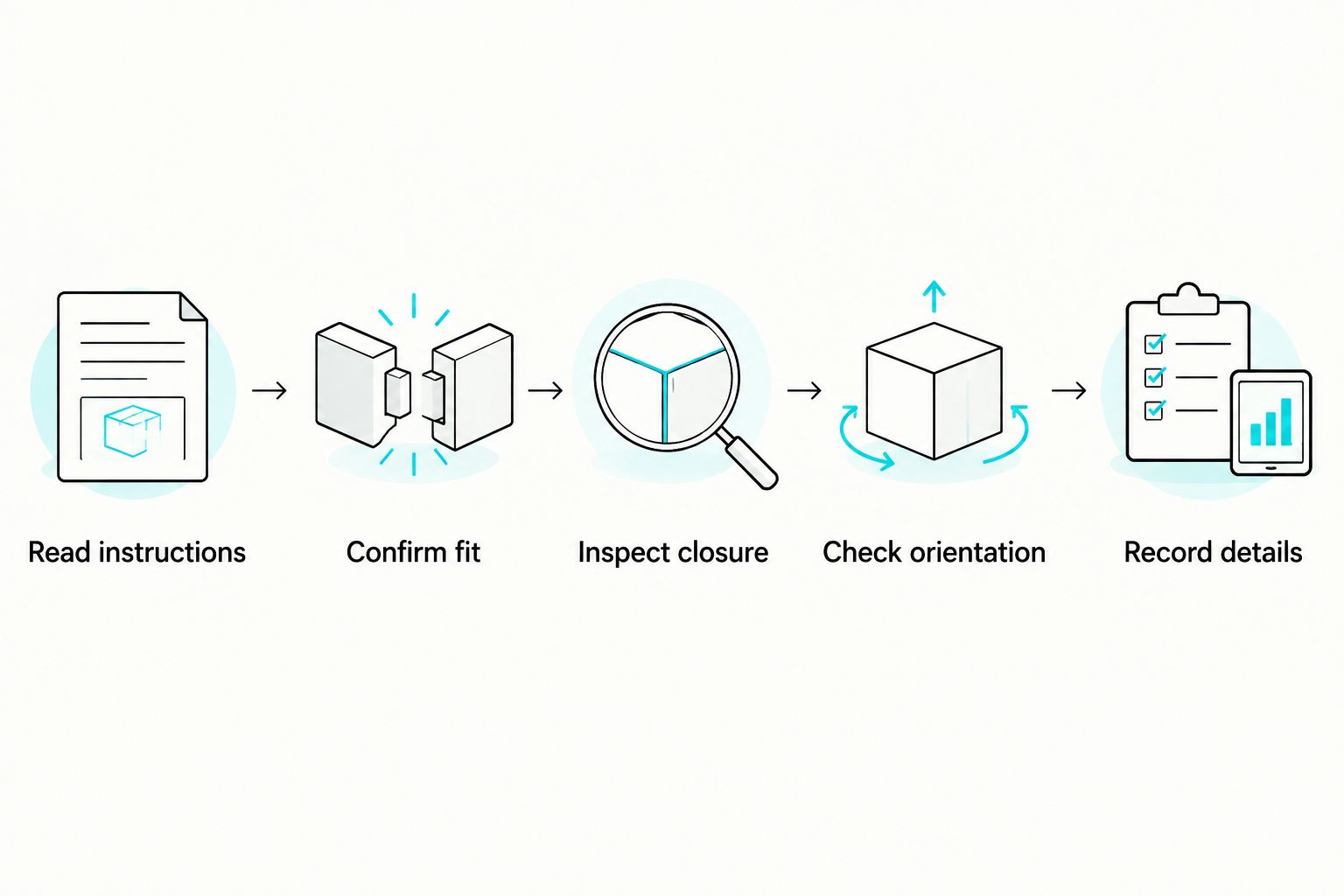
For a 2026 reorder record, save the exact item reference rather than relying on a description such as the usual amber vial. Record the chosen vial option and closure type separately so a later buyer can identify what was ordered.
A reorder record supports consistency. It does not replace checking the current listing or inspecting the shipment when it arrives.
What should you compare when buying prescription vials?
Compare the complete container-and-closure choice, not just the word reversible. Your order needs to match the prescription packaging you intend to use and the way your staff will handle it.
| Buying check | What to confirm | What not to assume |
|---|---|---|
| Closure mechanism | The stated opening action and available instructions | Every push-down cap uses an identical motion |
| Vial and cap match | The specified compatible combination | Similar-looking caps are interchangeable |
| Selected vial option | The option shown on the order | A product photo establishes capacity |
| Order contents | What the listing says is included | Every listing contains the same components |
| Delivered total | Current item and delivery charges at checkout | A displayed item amount is the complete order total |
Keep temporary offers out of your standing buying instructions. Your 2026 purchasing record should point staff to the current listing and checkout details rather than preserve an old promotion.
The listed Fujimochi prescription-vial product is relevant when you want an amber vial with a reversible push-down closure. Its description does not, by itself, confirm fit with your existing loose caps or every detail needed for ordering; verify those points before committing to a purchase.
Choose on confirmed fit and clear instructions, then compare the current delivered total. A lower item amount does not answer whether the closure is right for your workflow.
Can you put a reversible cap on any prescription vial?
- Use a reversible cap only with a vial specified as compatible with that closure. A cap that appears to attach is not enough evidence that the combination will function as intended.
Keep replacement caps identifiable rather than mixing unfamiliar closures together. If the original product reference is unclear, confirm the match before using the cap for dispensing.
Does turning the cap over keep it child-resistant?
- Turning a reversible cap to its easy-open side changes the opening mode and removes the child-resistant opening action. Do not present the reversed configuration as providing the same protection.
Explain that difference whenever the configuration changes. The decision should follow the pharmacy’s process and applicable requirements, not a casual assumption that either side is equivalent.
How should staff explain a push-down cap at pickup?
Show the patient the opening action on the actual dispensed closure, then ask them to demonstrate it back. A brief hands-on check is more useful than pointing to a cap and saying it is the standard kind.
Name the configuration plainly. Explain whether it is child-resistant or easy-open, and remind the patient that either container still needs appropriate storage away from children.
FAQ
What are reversible cap vials?
Reversible cap vials use a cap that can be turned over to provide child-resistant and easy-open configurations. The cap’s orientation determines the opening mode, so check the instructions for the specific closure.
Do I push down and turn to open every reversible cap?
Do not assume every reversible cap uses an identical motion. Push-and-turn designs require downward pressure while turning, but the directions for your actual closure determine how to open it.
Are reversible caps childproof?
No, reversible caps are not childproof. A child-resistant configuration does not eliminate the need for correct closure and storage away from children.
Can I turn the cap over if a patient struggles to open it?
Refer the change to the pharmacist rather than automatically reversing the cap. The easy-open orientation is not child-resistant, and its use must follow applicable requirements and the pharmacy’s dispensing process.
Can I reuse a cap from a different prescription vial?
Do not assume a cap from another prescription vial is compatible. Confirm the specified vial-and-cap match and inspect the components before use.
What should I check before ordering reversible cap vials online?
Check the closure mechanism, compatible vial, selected option, order contents, and current delivered total. Keep the item reference so the next buyer can identify the same product without relying on a photograph.
Does Fujimochi sell amber vials with reversible caps?
Yes, Fujimochi lists RX amber vials with reversible caps and describes a two-piece closure with a push-down mechanism. Check the current product page for ordering details and confirm any compatibility questions before purchasing.
One last thing
The smallest handling detail is the one to make explicit: a reversible cap can be present but facing the wrong way for the intended dispensing configuration. Add an orientation check to your 2026 closure procedure, alongside checking that the cap is properly seated.
Keep one clear opening explanation in staff training and one clear item reference in purchasing records. That connects the buyer’s choice to the closure the patient actually receives, without mixing purchasing assumptions with dispensing decisions.

