
Some probiotics need refrigeration; others are labeled for room-temperature storage. Follow the storage instructions on your exact product, including any directions that change after opening. A probiotic’s storage label—not the word probiotic on the bottle—determines where you should keep it.
- Do probiotics need refrigeration? Some do; follow the exact product label before and after opening.
- Shelf-stable probiotics do not automatically need refrigeration; room-temperature storage still requires protection from excess heat.
- A warm delivery needs product-specific guidance, not an automatic decision to keep or discard it.
- Fujimochi sells vitamins and supplements; check each probiotic’s storage instructions before ordering.
Why this matters
Buying a probiotic and storing it correctly are separate decisions. A bottle can arrive with clear refrigeration instructions, room-temperature directions, or instructions that change once you open it. Treating every probiotic the same creates avoidable confusion.
For a 2026 purchase, read the storage directions before choosing where the bottle will live. If you shop for supplements through Fujimochi, check the exact item rather than assuming every probiotic follows the same rule. Keep household supplement decisions separate from your pharmacy’s prescription-vial purchasing.
Do probiotics need refrigeration?
Probiotics need refrigeration when their product instructions require it. A shelf-stable probiotic can be stored without refrigeration under its stated conditions, but shelf-stable does not mean heatproof. Neither category gives you permission to ignore the label.
Use this comparison when reading a bottle or product listing. These are storage categories, not recommendations for specific brands.
| Label instruction | Best for | What to do | Main limitation |
|---|---|---|---|
| Keep refrigerated | Buyers who can maintain the required storage conditions | Store as directed and check handling instructions before travel | Requires access to suitable refrigeration |
| Store at room temperature | Buyers who need storage without a refrigerator | Follow the stated temperature and moisture precautions | Does not mean the product tolerates a hot car or direct sun |
| Refrigerate after opening | Buyers who can refrigerate the bottle once opened | Change storage when you first open it | Unopened storage directions no longer tell the whole story |
Do not choose a storage method from a similar-looking bottle. Products from the same brand can have different instructions, and a capsule’s appearance does not reveal its storage requirements.
When checking a probiotic in 2026, match the product name, formulation, and package you actually have. An old purchase record or a remembered instruction is not a substitute for the current label.
Refrigerated probiotics: follow the cold-storage instructions
A refrigerated probiotic belongs in the storage conditions specified by its manufacturer. Read the entire storage statement, including any temperature range and directions about keeping the container closed.
The practical advantage is clarity: the label tells you that refrigeration is part of the product’s care. The limitation is planning. You need to think about the trip home, overnight stays, and any situation where a refrigerator is unavailable.
Before buying, ask:
- Can you store the bottle as directed at home?
- Do the handling instructions address time outside refrigeration?
- Can you maintain the required conditions while traveling?
- Do you know whom to contact if the delivery arrives warm?
Do not invent an acceptable time outside the refrigerator. Different products require different guidance. A general answer from a friend or a discussion forum does not establish the handling limits for your bottle.
Shelf-stable probiotics: room temperature still has limits
A shelf-stable probiotic does not require refrigeration when its directions permit room-temperature storage. That makes it a practical option for buyers who do not want refrigerated storage, provided they can meet the label’s other conditions.
The trade-off is easy to miss. A room-temperature label does not make a bathroom, sunny windowsill, or parked car an appropriate storage location. Follow any directions concerning heat, moisture, and the original container.
Do not put a shelf-stable product in the refrigerator just because colder sounds better. Refrigeration is not a substitute for following the instructions. If the label leaves the question unresolved, ask the manufacturer whether refrigeration is appropriate for that exact product.
Keep the bottle closed as directed. A convenient pill organizer is not automatically an equivalent replacement for the original packaging; confirm that transferring the product is appropriate before changing containers.
Probiotics labeled “refrigerate after opening”
Some products distinguish between unopened and opened storage. If your label says to refrigerate after opening, opening the bottle is the point when the storage rule changes.
This arrangement allows unopened storage under the stated conditions, but it adds a task you need to remember. Do not leave the opened bottle in the same cupboard simply because that was correct before opening.
Read any instructions about how long to use the product after opening. If an opening date matters under those instructions, mark it on the package without covering the storage statement, expiration date, or lot information.
Follow both the expiration date and any separate after-opening directions. One instruction does not cancel the other.
Why probiotic storage requirements vary
Probiotic storage varies because products are not interchangeable. The organisms, formulation, packaging, and conditions used to establish shelf life all matter. You do not need to assess those technical details yourself; the practical result belongs in the manufacturer’s directions.
Use these factors to understand why copying another product’s storage routine is a poor shortcut:
- Organisms: Different probiotic organisms do not share one universal storage requirement.
- Formulation: The finished product matters, not just the organism named on the front.
- Packaging: The original container and its closure are part of the storage instructions.
- Heat and moisture: Exposure conditions matter even when refrigeration is not required.
- Opening status: Instructions can change after the package is opened.
- Shelf-life conditions: The expiration date assumes the product has been stored as directed.
A higher advertised organism count does not answer the refrigerator question. Neither does a label calling the product advanced, daily, or extra strength. Look for the actual storage statement instead of trying to interpret marketing language.
Your 2026 probiotic storage checklist
Use this sequence before ordering and again when the package arrives. It keeps the decision tied to the bottle rather than to a general rule about probiotics.
- Read the label. Find the storage statement and any separate directions for opened containers. If you cannot find them before buying, request them.
- Check delivery. Review the seller’s stated handling information. On arrival, inspect the package and follow any enclosed instructions.
- Choose storage. Put the product somewhere that meets its stated conditions, rather than leaving it where you unpacked it.
- Plan travel. Check the product-specific guidance before taking a refrigerated bottle away from home.
- Keep details. Retain the packaging information you would need to ask about a handling problem, including the lot and expiration date.
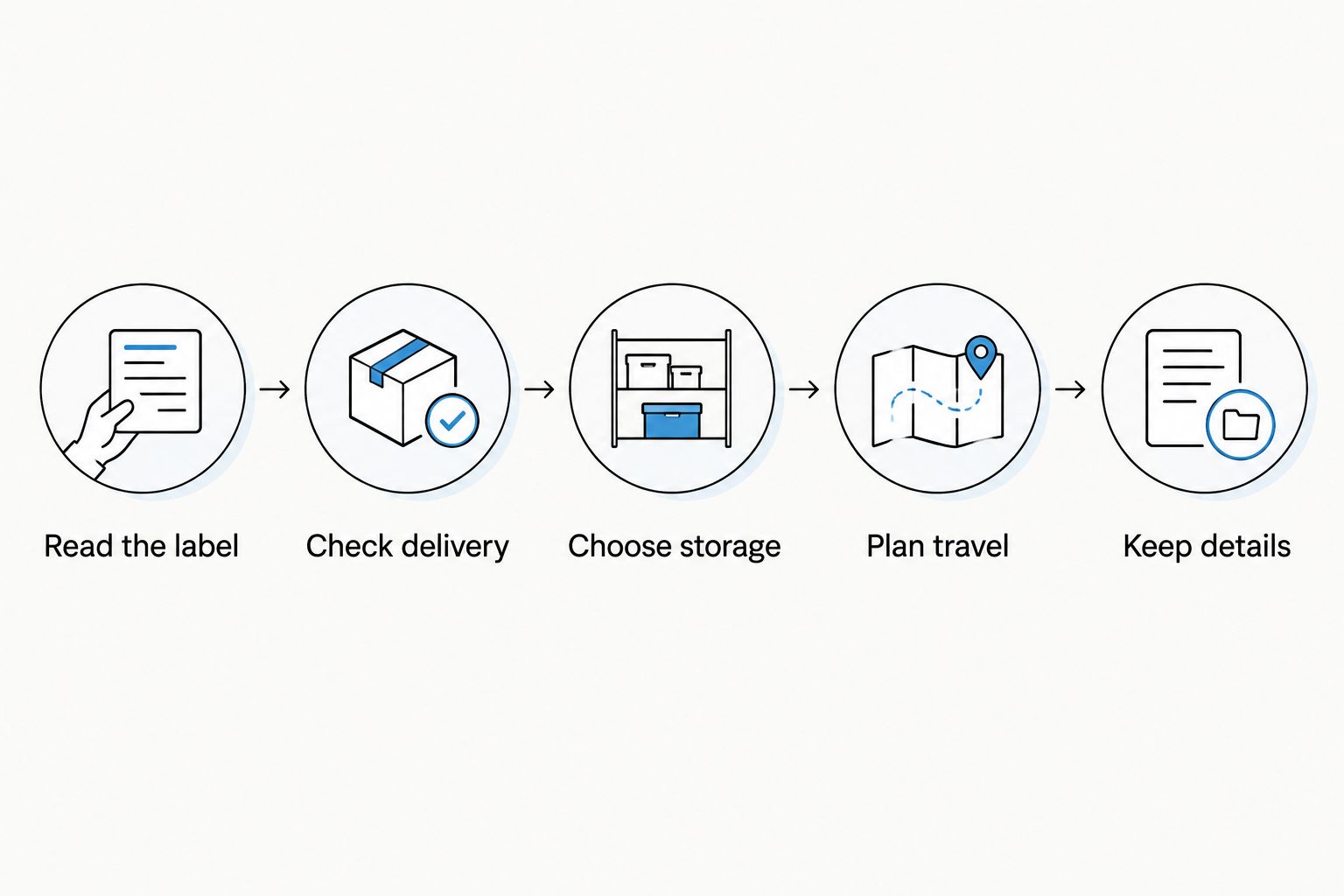
If you are buying for someone else, include the storage directions when you hand over the bottle. Do not assume the recipient knows that it needs refrigeration or that its instructions change after opening.
What should you do if refrigerated probiotics arrive warm?
A warm delivery requires product-specific advice. Package temperature alone does not establish whether the product remained within its handling limits, and feeling the bottle cannot measure the condition of the organisms inside.
Keep the packaging and record what you observed. Useful details include the delivery date, when you brought the package indoors, the product name, and the lot information. Describe what happened without guessing at a temperature you did not measure.
Contact the seller or manufacturer and ask whether the shipment meets that product’s handling guidance. Follow the labeled storage instructions while you seek advice. Putting the bottle back in the refrigerator does not prove that an earlier temperature exposure was acceptable.
Do not treat the presence or absence of a cold pack as the full answer. Ask about the specific product and shipment rather than assuming every refrigerated probiotic uses the same delivery method.
Can you refrigerate a shelf-stable probiotic?
A shelf-stable label does not automatically instruct you to refrigerate the product. Use the stated storage conditions, and ask the manufacturer if you want to store it differently.
The useful question is not whether a refrigerator seems more protective. It is whether refrigerated storage is appropriate for that formulation and container. Keep the product in its original packaging unless its instructions permit another arrangement.
Does refrigeration make a probiotic better?
Refrigeration does not establish that a probiotic is better than a shelf-stable product. It describes a storage requirement, not a ranking of quality or suitability.
Choose a product you can store correctly, then ask a pharmacist or other qualified healthcare professional about personal-use questions. Do not switch products solely because one bottle sits in a refrigerator and another sits on a shelf.
Where shopping fits into the decision
Fujimochi is best for buyers seeking supplements and pharmacy packaging from a pharmacist-owned store. Its supplement selection includes Florajen probiotics, but the name alone does not establish the storage instructions for an individual item. Check the exact product before ordering.
For independent pharmacy buyers, keep supplement receiving instructions separate from prescription-vial purchasing records. A vial reorder does not answer how an incoming probiotic should be handled. Give each product category its own purchasing and receiving checks.
FAQ
Do all probiotics need to be kept in the refrigerator?
No, not all probiotics need refrigeration. Follow the exact product label: some require refrigeration, while others permit room-temperature storage or require refrigeration only after opening.
How do I check probiotic storage instructions in 2026?
Read the storage statement on the current product package, including any after-opening directions. Match any online guidance to the exact formulation you have rather than relying on a similar product or an older purchase.
Are shelf-stable probiotics better for travel?
Shelf-stable probiotics are more practical for travel when you can meet their labeled storage conditions without a refrigerator. They still need protection from conditions the label excludes, including excess heat or moisture.
Can I take a refrigerated probiotic that was left out overnight?
Ask the manufacturer for guidance on that exact product before deciding whether to use it. Report how long it was outside refrigeration and the conditions you know; there is no universal overnight allowance for all probiotics.
Will putting probiotics back in the fridge fix heat exposure?
Putting probiotics back in the fridge does not establish that earlier heat exposure was acceptable. Follow the storage label and ask the manufacturer to assess the handling situation.
Can I tell whether my probiotic is still good by looking at it?
Appearance alone cannot confirm that a probiotic still meets its stated live-organism count. Check the expiration date, storage history, and manufacturer’s guidance rather than relying on how the capsule looks.
Does a higher probiotic count mean it needs refrigeration?
A higher advertised probiotic count does not determine refrigeration requirements. Read the storage statement on the exact product; the count on the front of the package is not a storage instruction.
One last thing
Before your next probiotic reorder in 2026, photograph the storage statement as well as the front label. That gives you a useful reference when packing for a trip or explaining storage to someone else. Check the replacement bottle again when it arrives; the current package remains your instruction source.
Related guides
For independent pharmacy buyers, these prescription-packaging resources are separate from the supplement guidance above:

